About
Cosmology from weak signals in the microwave sky.
I work on the faint signals hidden in CMB polarization maps, building analysis methods that help turn precision sky measurements into tests of fundamental physics.
I am a postdoctoral fellow at the University of California, San Diego, working on precision cosmology with the Cosmic Microwave Background. My research develops statistical and computational methods for extracting weak polarization signals from survey data, with emphasis on gravitational lensing, B-mode polarization, delensing, and cosmic birefringence.
A central aim of my work is to connect theoretical signatures of fundamental physics with the practical realities of modern CMB observations: foregrounds, instrumental systematics, map-level simulations, likelihood construction, and cross-survey consistency. I contribute to analyses and forecasts for experiments including POLARBEAR, Simons Array, Simons Observatory, LiteBIRD, and CMB-S4.
Recent Paper
Latest publication
Latest Work
Differential Polarization Calibration: A Consistency Test for Cosmic Birefringence
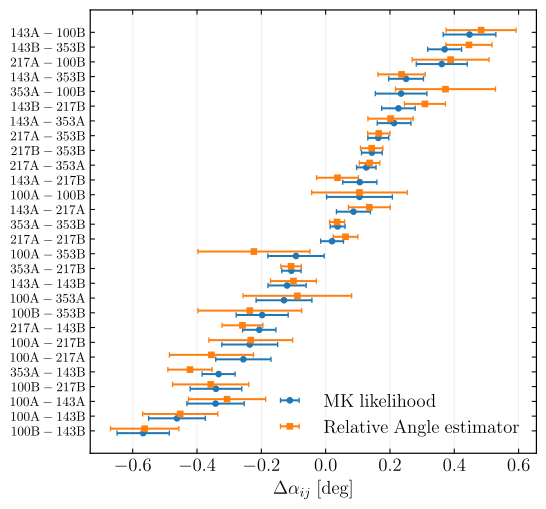
The cosmic microwave background birefringence angle is exactly degenerate with a common instrumental polarization-angle offset. The Minami--Komatsu(MK) likelihood separates these quantities using Galactic foreground polarization, so its inferred detector angles merit a diagnostic that does not reuse the foreground- model.